
As a tenant, if I repair something on my own in the unit, the landlord must reimburse me for my time and materials within seven days.
Appliances or fixtures sometimes break or malfunction in a rental unit. That’s normal. What’s not normal (or legal) is for a landlord to ignore your repair requests — or worse, to harass you or threaten eviction just for asking. Let’s walk you through your rights as a tenant when it comes to repairs, and strategies to work out problems.
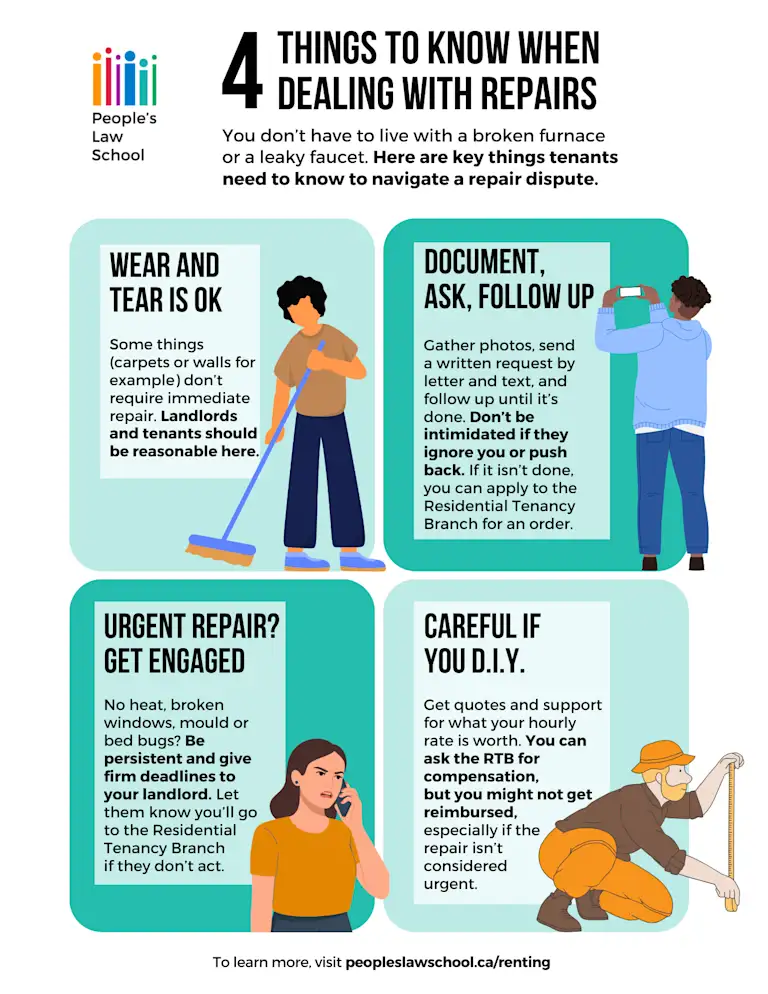
What you should know
Here’s how it goes in your dreams: you call or text your landlord about a broken appliance, and someone shows up the next day to repair it. But in reality, things are rarely so simple. Indeed, these situations can be tense, especially if you have a difficult relationship with your landlord.
We’re here to help. Below, under work out the problem, we walk you through practical steps to help make your repair request less stressful. Under who can help, we spotlight some key supports. Plus, we have more tips in our five steps to deal with any legal problem.
Landlords are responsible for ensuring that rental units meet health, safety and housing standards, and are reasonably suitable for occupation. The details are spelled out in the Residential Tenancy Branch policy guideline on landlord and tenant responsibilities.
Here’s a list of things that a landlord has to keep on top of in your unit:
heating, plumbing and electrical fixtures
walls, floors and ceilings
locks, keys and any access device
smoke detectors and fire escapes
mould issues
insect or bug infestations
window cleaning (from the outside)
painting, at reasonable intervals
any appliances that were included in your tenancy agreement
A landlord also has to take care of common areas, including things like:
lighting fixtures
fire escapes
yard maintenance, if it’s a shared space
elevators
Tenants are responsible for maintaining a reasonable standard of health and safety in their units. This doesn’t mean the unit has to be perfectly clean at all times, but basic maintenance is expected to keep things working properly. For example:
taking care of your carpets
wiping dirt and dust from baseboards and heaters
taking out garbage
replacing burnt-out lightbulbs
If you’ve been living in your unit for a while, some wear and tear is expected. And your landlord cannot charge you for repairing it. For example, if your carpets start to fray and get discoloured simply because they are old and wearing out, the landlord can’t say this is your fault and charge you to replace them.
But if you’ve damaged your unit — say you put excessive nail holes in the wall, or the washing machine broke down because you overloaded it — you’d be on the hook to pay for the repair. In this case, consider how you’d want to approach your landlord about this (we suggest strategies below). Think twice before trying to do the repair yourself, since it might end up costing even more to fix if it isn’t done right.
Your landlord must promptly address issues that affect your ability to live comfortably and safely in your home. Exactly how promptly they have to act will depend on what needs to be fixed. A broken heater in January requires immediate attention; bird droppings on your window (while no fun!) are far less of a priority. But even repairs that aren’t urgent (like a door lock that sticks, but still works) should be handled within a reasonable period, typically a few days to a couple of weeks.
It's important to understand that landlords aren't required to replace items simply because they're old or outdated — only when they no longer work as intended. Carpets might last 10 years, while windows could last 20-25 years. (The Residential Tenancy Branch’s policy guideline on useful life sets out estimates of useful life for several common items in rental units.) If your carpet is worn but still usable, or your windows are old but still open and close and keep out the weather, your landlord doesn't have to replace them. However, once an item has reached the end of its useful life and stops functioning properly — like a window that won't close or carpeting that's so worn it's unsanitary — then your landlord must repair or replace it. This balance helps ensure you have a safe, livable home while recognizing that normal wear and tear happens over time.
If your building isn't meeting safety codes — because of problems such as blocked hallways, non-functioning fire alarms, missing fire doors or other hazards — you have several options to raise concerns (some of these steps are covered under work out the problem, below):
Consider chatting with other tenants in the building. See if they’ve noticed similar issues or have already notified the landlord about them.
Your next step should be to notify your landlord in writing about the specific safety issues, giving them a chance to fix the problems. See step 2 below for more.
If your landlord doesn't respond or refuses to make necessary repairs, you can contact your local municipality's bylaw enforcement or building inspection department. They have the authority to inspect properties and require landlords to comply with building and fire codes. You can also reach out to your local fire department if you have concerns about fire safety specifically. Know your goal here. You might want to start with an “asking for a friend” approach — are these circumstances I’m describing actually a code violation? — rather than filing a formal complaint straightaway.
The Residential Tenancy Branch can help if the code violations affect your ability to live safely in your unit. You may be able to apply for dispute resolution to address the issues — or even end your tenancy early if the problems are serious enough. See step 6 below for more.
Some landlords may react very negatively to making complaints to the Residential Tenancy Branch or to local governments. Some may even harass or attempt to evict tenants in retaliation. If you get an eviction notice and want your tenancy to continue, you can dispute the eviction. Just make sure to act quickly. Here, we step you through dealing with an eviction.
“I noticed black spots spreading across the bathroom ceiling, but I felt anxious about confronting the building manager — I rarely saw her, and when I did, I always felt like I was bothering her. But I chatted with other tenants in the building, and they supported me. I took photos and sent a clear written request. The landlord responded within two days. A remediation company arrived that week, fixed the ventilation problem causing the moisture, and treated all the affected areas. I kept copies of everything just in case the mould came back.”
– Maya, Surrey, BC

If you discover mould in your rental unit, it's important to act quickly, both to protect your health and to resolve the issue. Start by notifying your landlord in writing immediately. Include photos of the mould, and describe where it is and how extensive it appears. (Keep a copy of this exchange for your records.)
While waiting for repairs, protect yourself by avoiding direct contact with the mould. Keep the area well-ventilated. Use a dehumidifier if possible. And move any belongings away from the affected area.
If the mould is extensive or you're experiencing health symptoms like respiratory issues or allergic reactions, consider staying elsewhere (if it’s possible). If you have to pay for other accommodations, you might be able to get this money back from your landlord by applying for dispute resolution with the Residential Tenancy Branch (see step 6 under work out the problem, below). But keep in mind that the alternative accommodations have to be reasonable (no pricey hotel stays).
Mould remediation often requires professional treatment, not just surface cleaning. Your landlord is responsible for fixing both the mould and the underlying moisture problem causing it, whether that's a leak, poor ventilation or another issue. If your landlord doesn't respond within a reasonable time or refuses to address the problem properly, you can contact your local health authority to request an inspection. (They can order the landlord to remediate health hazards.) You can also apply to the Residential Tenancy Branch for dispute resolution. Depending on the severity, you might seek an order requiring repairs, a rent reduction for the period the unit wasn't fully livable, or even permission to end your tenancy early without penalty.
As soon as you notice signs of bed bugs, notify your landlord in writing immediately. Include photos if possible. This is an urgent matter that requires immediate attention from your landlord.
Bed bug infestations require professional pest control treatment. Your landlord is generally responsible for arranging and paying for this service. It might be inconvenient, but it's important to cooperate fully with any pest control treatments. These typically require multiple visits, and also prep work by you (like decluttering and laundering items).
If you need to move out during the infestation and have to pay for other accommodations, you might be able to get this money back from your landlord by applying for dispute resolution with the Residential Tenancy Branch (see step 6 under work out the problem, below).
If your landlord does try to evict you or retaliate after you've asked for repairs, you can challenge this at the Residential Tenancy Branch by applying for dispute resolution. In this situation, make sure you’re prepared — you can’t just say that the landlord is acting in retaliation and expect to win. You need to show that the landlord’s reason to evict you is incorrect.
(This is an outcome your landlord does not want. They could face additional consequences — including fines — and a pattern of retaliatory behavior can seriously harm their credibility in any future disputes.) Keep detailed records of all your repair requests, your landlord's responses and the timing of any eviction notices or other actions. This documentation will be crucial if you need to prove retaliation.
Work out the problem
There can be serious power differences in play in these conversations. Your landlord might have an intimidating personality, be generally difficult to deal with, or dismissive of your complaints. And discrimination issues are unfortunately common in landlord-tenant situations in BC.
We’ll walk you through some steps you can take to get a repair done with as little disruption to your day to day life.
“When my heating broke in January, my landlord ignored my calls for weeks. I felt powerless and scared. I talked to other tenants in the building about this, and they gave me some helpful tips on what to do next. When my landlord continued to refuse, I filed with the Residential Tenancy Branch — my friend helped me prepare, and came to the hearing for support. The arbitrator ordered the repairs within 10 days. My landlord finally fixed the furnace, probably realizing I wasn't going to back down.”
– Angela, Vancouver, BC

Before you approach your landlord, take time to build your case so you're coming from a position of strength. Take clear photos or videos of the problem from multiple angles. Capture the full extent of the issue, whether it's a leaking ceiling, broken appliance, mould growth, or safety hazard. Write down when you first noticed the problem, how it's affecting your daily life, and any conversations you've already had with your landlord about it. If the issue affects other tenants, consider talking with your neighbours — a collective concern can carry more weight. Ask other tenants or friends whether they’ve ever dealt with a repair request. What approach worked best for them?
You're not being difficult or demanding by documenting problems in your home — you're protecting yourself and ensuring you have evidence if things don't go smoothly.
Prepare a written request to the landlord that they deal with the problem.
First off, know your context
What kind of rental are you in? Is it a suite in a single-family home? Or an apartment in a large complex? The difference is important. Landlords who only manage one or a handful of units might be easier to reach and more responsive. But larger units run by a property management company might have specific ways to get in touch with them. Figure out the correct contact information or protocols first.
Put the repair request in writing
When you're ready to contact your landlord, put your request in writing rather than relying on a phone call or casual conversation. This creates a clear record that you asked for help and when. Be clear, factual and polite. Keep your tone respectful but don't apologize for needing things fixed — you deserve to live in a properly maintained space.
Describe the specific problem. For example, "The window seals have failed and the unit is getting very drafty” If you can, attach a photo or two. Explain how the problem is affecting you ("I’m cold much of the time and am overusing the heating source to compensate for this.”) Clearly ask your landlord to arrange a repair. Include the date. For urgent requests, clearly state that your landlord must act immediately because of the effect on your health and safety.
If you need help, ask our chatbot Beagle+ to prepare a draft of this letter.
Send this request in a way that gives you proof of delivery — email is great because you'll have a record. If you're delivering a written letter, keep a copy for yourself and consider taking a photo of it before you hand it over.
Once you've made your request, give your landlord a reasonable amount of time to respond. (For non-emergency issues, allow a few days. Emergencies like no heat or major water leaks need immediate action.) If your landlord agrees to make the repair, follow up in writing (even just a quick email or text) to confirm the details: when will the repair happen, who will be doing the work, and will you need to be home to provide access?
If the agreed-upon date passes and nothing happens, reach out again politely but firmly: "Hi [Landlord's name], I wanted to follow up on the [issue] repair that was scheduled for [date]. Can you let me know when this will be completed?"
Following up can feel uncomfortably pushy, but remember: you are not being unreasonable. You're simply holding someone accountable for their legal responsibility. Persistence might make the difference between a problem that gets fixed and one that drags on indefinitely.
“My landlord is generally difficult, but when he finally fixed the leaking pipes after my third request, I sent a quick "thanks for getting that done" text. Did he deserve praise for doing his basic job? No. But I'm playing the long game here. A little goodwill now might make the next repair request less painful. Sometimes you have to be strategic when you're the one with less power.”
– Mina, Richmond, BC

When your landlord responds promptly and takes care of the repair properly, a simple email or text saying "Thank you for arranging the repair so quickly, I really appreciate it" acknowledges their responsiveness and helps build goodwill for the future. This might seem unnecessary, especially if you feel like they were just doing what they're legally required to do. But the reality is that the landlord-tenant relationship works best when there's mutual respect. A pattern of positive interactions can make future repair requests easier and less stressful for everyone involved.
If your landlord ignores your request, delays unreasonably, refuses to make the repair — or worse, responds with threats, intimidation, or hints about eviction — it's time to be more firm while still protecting yourself. Send a final written notice that clearly states the problem hasn't been resolved. Refer back to your previous request (including the date), and give them one more specific deadline to complete the repair.
In this letter, you can mention that if the issue isn't addressed, you'll move on to other options such as contacting the local health authority, bylaw enforcement, or the Residential Tenancy Branch. Keep your tone professional and factual, even if you're frustrated. This document may be read by a judge later, and you want to come across as reasonable.
If your landlord has tried to intimidate you, or has suggested they might evict you for asking for repairs, state clearly in writing: "I'm aware that tenants in BC have the right to request necessary repairs without facing retaliation or eviction."
It's completely understandable you might feel scared or powerless when a landlord pushes back, especially if you're worried about losing your home. But remember: their behavior is illegal, and standing firm now — with documentation — gives you strong protection if things escalate.
For an urgent repair,, you might want to consider fixing the problem yourself and having your landlord reimburse you for it. If that’s the case, plan to use only licensed or experienced professionals who can provide you with an invoice. (This is crucial if you intend to ask the Residential Tenancy Branch to order your landlord to reimburse your costs.) If you’ve done the work on your own, the branch might have a harder time assigning a dollar amount to the labour, though they’ll still consider your time cost in a claim for reimbursement.
If your landlord continues to refuse to make necessary repairs despite your requests, your next step is to file for dispute resolution with the Residential Tenancy Branch. This move is quicker and easier than you might think.
You can apply online or by mail. There's a small filing fee (currently $100, though you can request a fee waiver if you're experiencing financial hardship). In your application, you'll explain the problem, what repairs are needed, how long the issue has been ongoing, and what you've done to try to resolve it. This is where all your documentation becomes crucial. Attach copies of your written requests, photos of the problem, your landlord's responses (or lack thereof) and anything else that shows you've tried to resolve this reasonably.
You can try asking for any or all of the following at the Residential Tenancy Branch (although you might not get it all):
the landlord to complete the repairs
rent reduction for the time you've lived with the problem
compensation for related costs
permission to end your tenancy if the situation is serious enough
The process can feel intimidating, especially if you've never been involved in a legal proceeding before. But RTB hearings are designed to be accessible to people without lawyers. For further support, consider reaching out to a tenant advocacy organization (see below, under who can help) or asking our chatbot Beagle+ for help.
Common questions
Winning your case at the Residential Tenancy Branch and getting an order requiring your landlord to make repairs is a significant victory. But unfortunately, some landlords still refuse to comply even after an arbitrator has ruled against them. If your landlord hasn't completed the repairs by the deadline in the order (or is simply ignoring the order altogether), you have enforcement options available to you. You can mix and match the below tactics depending on your situation:
Contact the Residential Tenancy Branch Compliance and Enforcement Unit to request compliance assistance — they can send formal notices to your landlord and may be able to help facilitate compliance.
File the RTB order with the BC Supreme Court and enforce it like any other court judgment. Note that this can be a tricky process, since the process at the Supreme Court is different from the RTB. Consider asking Beagle+ for help on the steps involved.
Apply to the RTB for a monetary order to compensate you for the landlord's non-compliance, including the cost of making the repairs yourself if you had to.
If the situation has become unlivable and your landlord is clearly not going to comply, you may be able to apply for an order ending your tenancy early without penalty and potentially awarding you moving costs.
It's deeply frustrating and demoralizing when a landlord defies a legal order, and you may feel like the system has failed you. But don't give up. The enforcement mechanisms exist, and landlords who flagrantly ignore RTB orders can face serious consequences.
If your landlord serves you with an eviction notice after you've requested repairs or filed an RTB claim, don't panic — but do act quickly, because you have limited time to respond.
First, read the notice carefully to understand what type of eviction it is and what reason your landlord is giving. In BC, landlords can only evict tenants for specific legal reasons, and the timing of an eviction notice right after a repair request is a major red flag that it could be retaliatory, which could be relevant if your landlord issues a notice to end tenancy for landlord’s use of property.
File a dispute resolution application challenging the eviction within the appropriate deadline -- it can be as little as 5 days after you receive the eviction notice. See work out the problem, above, in step 6. In your application, explain the timeline. Say when you requested repairs, how your landlord responded, and when the eviction notice was served. Include all your previous documentation showing the repair requests and any intimidation or threats.
It can be scary to receive an eviction notice, especially when you feel it's retaliation for standing up for your rights. But you can still defend yourself, you just need to be thoughtful about your approach. Just saying they are trying to evict you in retaliation for requesting a repair is not a good enough defence — be prepared to explain why the landlord’s grounds to evict you are unreasonable. Don't let fear stop you from fighting back — acting quickly and getting support can mean the difference between losing your home and staying in your rental with your rights protected.
Who can help

Tenant Resource & Advisory Centre (TRAC)
Help and advice for tenants experiencing legal problems.

Residential Tenancy Branch
BC government agency that helps tenants and landlords resolve problems.
Tenant Resource & Advisory Centre (TRAC)
Help and advice for tenants experiencing legal problems.

Access Pro Bono Residential Tenancy Program
Free legal assistance and representation to low- and modest-income tenants.
