
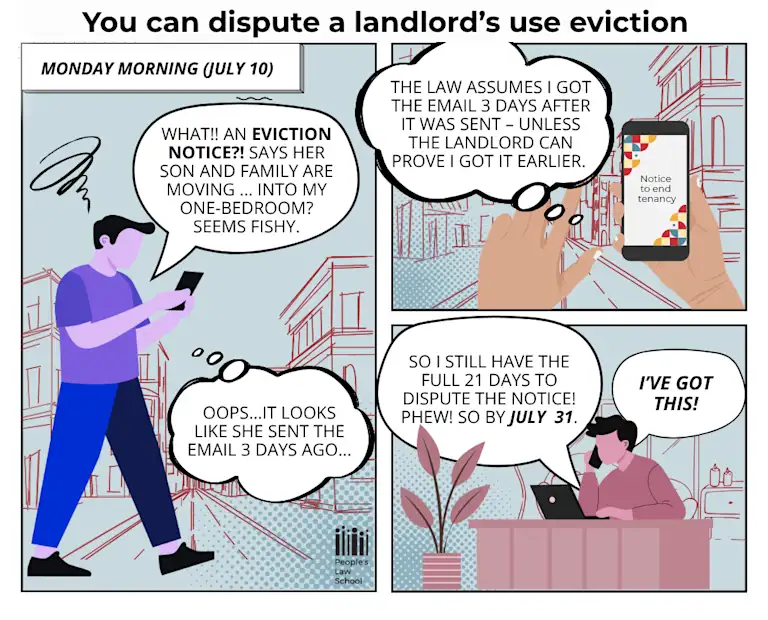
Your landlord can give you notice to end your tenancy if they (or a close family member) plan to move into the rental unit. Learning you might be forced out of your home can turn your whole life upside down. But you can dispute the notice. We walk you through how to deal with a landlord's use eviction.
What you should know
Under the law in BC, your landlord can give you notice to end your tenancy if they, or a close family member, intend to move into the unit. If the rental unit is sold, the same rules apply. That is, your landlord can give you notice if the new owner wants to occupy the unit for themselves (or their close family member).
Here are some things you should know about a landlord’s use notice:
A close family member includes the landlord’s (or purchaser’s) parent, spouse or child. It also includes the parent or child of the spouse of the landlord (or purchaser). It does not include a sibling, cousin, aunt, or friend.
The landlord or purchaser (or their close family member) must intend to occupy the unit as a living space. We unpack this more below.
Your landlord must act in good faith. In other words, they intend to follow through on their stated plan to move in.
If you live in a rental building with five or more units, and the building isn’t strata-titled or is owned by one landlord, your landlord can’t end your tenancy for landlord's use.
If a family corporation is involved
A family corporation can own property and be a landlord. Anyone who has voting shares in the corporation can give you notice if they (or their close family member) want to move in.
"I've lived in my rental for more than 20 years. My landlord gave me notice saying he wants to move in. I felt panicked. Three months sounds like a long time, but it's not when you're 68 years old on a fixed pension. The waitlists for subsidized units are years long. A friend mentioned I could reach out to a housing advocate to help me find housing.”
– Xander, Rossland, BC

“Eviction” is often used to refer to any situation where a landlord has told you, or is otherwise pressuring you, to leave. But it’s important to understand where the eviction process actually starts. If you don’t get proper notice, you don’t have to move out.
Here’s the catch: if your landlord isn’t following the rules and you decide to move out anyway, you lose your right to dispute the eviction or get compensation later on. So it’s worth checking upfront whether everything is above board.
The amount of notice
For a landlord’s use notice, they must give you at least three months to move out. The notice should say the “effective date” to end the tenancy. That’s when you’re expected to hand over the keys and move out. It has to fall on the last day of your rental period. (For a fixed-term tenancy, your landlord cannot make you move out before the end of the term.)
How your landlord gave you notice also comes into play. Just because your landlord put the notice in your mailbox doesn’t always mean you’re assumed to have received it that day. Under the law, when you’re taken to "receive" the notice depends on the delivery method. If the notice was:
handed to you in person, you receive it the day you got it
mailed, you receive it the fifth day after it was mailed
emailed (and you've agreed to get documents by email), you receive it the third day after it was sent
attached to your door, you receive it the third day after it was attached
left in your mailbox, you receive it on the third day after it is left
Importantly, if your landlord has proof (like an email reply) that you received the notice earlier, then the actual date you did receive the notice will apply instead.
Say you pay rent on the first of the month. Your landlord tapes an eviction notice to your apartment door on October 31. If your landlord does not have proof you saw it any earlier, you're taken to have received it three days later — on November 3rd. With three full months' notice required, the earliest date your landlord can tell you to move out by is the end of February.
If the landlord tries to bypass the legal process
Some landlords may try to pressure you to leave "voluntarily" without going through the eviction process. In other words, you agree to leave without getting proper notice. A landlord may even try to sweeten the deal by offering you an amount of money to leave without notice. This is sometimes referred to as “cash for keys.” You don’t have to agree to this kind of arrangement if you don’t want to. If you do agree, you give up certain rights. Here we explain what you should know before signing a mutual agreement to end tenancy.
"I've lived in a basement suite for eight years. The suite is perfect for me. It’s accessible and close to my doctor's office. My landlord, who lives upstairs, gave me notice to leave. When I asked, she said she wants to use the space to give her hairdresser clients the option of coming to her. Can she really kick me out of my home so that she can occasionally have clients over?”
– Maria, Victoria, BC

Your landlord can't evict you just to leave the suite empty or turn it into an Airbnb. They (or their close family member) must genuinely plan to live in the unit, or use the unit as part of their living space. A living space is somewhere they sleep, eat, and spend time.
The unit should be a home, or part of it. This doesn’t mean they have to be there every day. In fact, the rental unit doesn't have to be their only home or their main home. And they can take vacations or be away sometimes. But they can't just stay there once in a while or leave it mostly vacant.
Here are some examples of what's allowed:
Your landlord can evict you from a basement suite to extend their living space. They could turn it into a kids’ playroom or a place to store their personal things.
A purchaser works in your city three days a week but their family lives somewhere else. They plan to live in the unit during those work days.
Your landlord's adult child is moving to your city for a job and needs a place to live.
Your landlord plans to move into the unit and take on paying roommates who share the bathroom or kitchen with them.
Home office or home business?
Your landlord can give you notice if they want to work from home in your unit, like working remotely. What if they run a business where customers or other employees come to the space — like a hair salon or daycare? That counts as commercial use and requires a different type of eviction.
“My landlord tried to increase my rent by $300. I knew that wasn't legal so I told them so. A week later, I got an eviction notice saying their son was moving in. I knew his son was a bigshot property developer. I doubt he wanted to move into my small apartment. I disputed the notice. The landlord couldn't answer basic questions about his son’s moving plans. The arbitrator cancelled the eviction. Turns out the whole thing was a lie. I'm so glad I followed my gut."
– Malee, Vancouver, BC

The law says your landlord must be acting in good faith. That means they are being honest about how they plan to use the rental unit. They can't have a hidden reason for evicting you, like wanting to rent the unit for more money.
Look for signs of a bad faith eviction
Many tenants don't fight eviction notices because they assume their landlord is telling the truth. Unfortunately, some landlords lie to get tenants out so they can charge more rent. Here are warning signs to watch for:
Your landlord recently tried to raise your rent above the legal limit.
You complained about repairs and got an eviction notice shortly after.
Your landlord has previously evicted tenants for landlord’s use but then never actually moved in.
Your landlord owns multiple properties or comparable vacant units at the property, and the possibility of them moving into your rental unit seems low.
If you see these signs, you have the right to question the eviction. If your landlord won't answer questions about their moving plans or gets defensive, that might be a red flag, too.
If you don’t accept the eviction, you can try to resolve the issue informally with your landlord. For example, you could try to negotiate a mutual agreement to end tenancy.
If these options don’t make sense in your situation, you can apply for dispute resolution. If you don’t dispute the notice, it means you have to move out. You have 21 days from when you receive the notice to apply to dispute it. Mark the deadline on your calendar right away. Set reminders so you don't forget.
At the hearing, you and the landlord each explain your side of the story to a person, called an arbitrator. They decide what each of you should do about the problem. The burden is on your landlord to prove that they (or a close family member) really do plan to move in for at least 12 months. If they can't prove this, the arbitrator should cancel the notice and your tenancy continues. Legally, you don’t have to prove that your landlord has dishonest intentions. That said, it’s a good idea to be ready with a clear explanation about why you think they’re acting in bad faith. And if you have any proof, it can help your chances of stopping the eviction.
Dispute resolution might sound intimidating and complicated, but you may be surprised how accessible it is. The process is designed to be used by people to navigate themselves, without the help of a lawyer. The hearing is usually held over the phone. It’s typically an hour long.
Get help to dispute an eviction notice
Preparing for a dispute resolution hearing takes time and energy. You'll need several hours to gather evidence, fill out forms, and get ready for your hearing. A community legal clinic may be able to walk you through an application. And the Tenant Resource & Advisory Centre may be able to help you dispute your notice.
If your landlord gives you notice to end the tenancy for their own (or a purchaser’s) use, the landlord must pay you one month's rent before you move out. The effect of this is that you get your last month rent-free.
You have two options:
Wait for your landlord to pay you before or on the day you move out.
Keep your final month's rent instead of paying it. Make sure you tell your landlord in writing that you're keeping the rent as compensation for the eviction. This way, they can't try to evict you for unpaid rent.
What if, down the road, you find out that your landlord didn’t use the rental unit as they said they would? You can make a claim for compensation equal to 12 months’ rent. The landlord, or their close family member, must have moved in within a reasonable time after you moved out. And they must occupy the unit for at least 12 months. We step you through how to apply to the Residential Tenancy Branch for this compensation.
Deal with a notice for landlord’s use eviction
Check that the landlord has given you proper notice
Using this checklist, make sure your landlord is playing by the rules. For the notice to be legal (and enforceable), it must:
❏ Be in the correct form. The form should have RTB-32L or RTB-32P on it.
❏ Be generated on the government portal. You’ll be able to tell they’ve used this process if the notice has a unique notice ID number in the top left corner. Here’s a sample of a generated form.
❏ State who is intending to occupy the unit — it must be the landlord, a purchaser or a close family member (see what you should know, above, for who qualifies).
❏ Tell you the date the landlord wants you to move out by. On the form it’s called the “effective date.” For these kinds of notices, it should be at least three months out.
❏ Be given to you by mail, by handing it to you in person, or by attaching it to the door of the rental suite. The form can be attached to an email, but only if you have previously provided an email for service.
The Tenant Resource & Advisory Centre has a template letter for when your landlord has given you an illegal eviction notice. If you decide to give this letter to your landlord, keep a copy for your records.
Check the timelines
If your landlord has given you proper notice, check the timelines:
First, use this calculator to figure out your window to apply for dispute resolution. You generally have 21 days to dispute a landlord’s use notice.
Second, look on the notice to confirm the day the landlord is telling you to move out by (the effective date).
Third, check whether they’ve calculated the effective date from the correct start date. The date you’re taken to have received notice depends on how the landlord gave it to you.
Set calendar reminders to keep you on task and stay on top of deadlines. In the meantime, you can take other steps to resolve the issue informally.
If your eviction notice has vague details about the landlord moving in, consider talking to your landlord to learn more about their plans. Before you reach out, think about what questions you want to ask. What information would help you understand whether this eviction is legitimate?
Pay attention to what your landlord tells you and whether their story stays consistent. If details keep changing each time you talk, or if their explanation doesn't make sense, this could be a sign they're not being honest.
Sometimes you learn important information from other sources. If repair people, property managers or neighbours tell you things that contradict what your landlord said, take note. These inconsistencies can be evidence that your landlord isn't acting in good faith.
Gathering evidence
If you suspect that your landlord is being dishonest, gather more evidence to support your position. Here are some examples of the kinds of evidence you can file with the Residential Tenancy Branch:
screenshots of ads listing the rental unit for higher rent
letters, emails and text messages
statements from witnesses who can back up your story
photos, videos or audio recordings
a journal documenting the date and times of any issues or communication with your landlord
If you have a sense that the possibility of your landlord moving into your rental unit is low, gather evidence that supports your narrative. For example, this could include:
a land title search showing that your landlord owns multiple properties
photos showing the state of repair or size of the unit
public profiles, posts or articles that indicate that the landlord is wealthy
statements from previous tenants or neighbours about a pattern of your landlord giving notice for their own use, and not following through
If you are not able to successfully dispute the notice, you may be able to use this evidence to get compensation for a bad faith eviction later on.
Dealing with the threat of eviction is stressful. It may even cause you to go into “flight” or “freeze” mode. If you’ve received notice, take a deep breath and try to gather your thoughts. Do a gut check. Do you think your landlord is being honest? Have you noticed any red flags that make you think it’s a bad faith eviction?
To make an informed decision, figure out what your legal rights are. The best way to do this is to connect with a legal advocate or a legal clinic. Many community legal clinics provide help with tenancy issues. Search online for a legal clinic in your area. As well, see our other options for free legal help below.
Once you have a solid understanding of the situation and your rights, focus on the outcome you want. Do you want to dispute the eviction with the Residential Tenancy Branch? Put your energy into finding housing as soon as possible? You can also try to negotiate a deal with your landlord. Consider asking Beagle+ to help you draft a letter to your landlord asking them for some flexibility. You can also try to negotiate a mutual agreement to end the tenancy.
Disputing the notice
It can feel daunting to take on your landlord. But you have the right to tell your side of the story and assert your rights.
If you want to dispute the notice, you can't be forced to move out while your dispute is being decided — even if the three-months notice has passed. If you win the dispute, the notice will be cancelled and the tenancy will continue. (That said, legally speaking, there’s nothing stopping your landlord from turning around and giving you another eviction notice after you’ve successfully disputed a notice.)
We have more on applying to dispute the notice at step 5 below.
Deciding to accept the eviction
You might decide that fighting the eviction isn’t the right choice for your wellbeing right now. That is a valid decision, too.
There’s a lot to consider here. Relocating comes with its own stresses and inconveniences. Evicted tenants often face a steep rent hike and difficulty finding housing they can afford in their area. And being pushed out of a neighbourhood usually means loss of community connections and services, longer commutes to work, moving schools and loss of social ties.
That said, if all signs point to your landlord genuinely planning to move in, you may decide to go ahead and move out. If you think your landlord is being shady, the prospect of fighting the eviction can feel daunting and draining. If you decide it’s too much trouble to take this on with your landlord, that’s your decision.
Help to find a new place to live
In tight rental markets, finding a new home can feel like trying to find a needle in a haystack. The Tenant Resource & Advisory Centre offers an online resource to help you search for rental housing in BC. You may also be able to connect with a housing advocate in your area to support you through this process. BC Housing offers subsidized housing, rental assistance programs, and a homeless outreach program if you find yourself with no fixed address or in temporary accommodation.
Reach out to those around you. This can help ease some of the overwhelm, both emotionally and logistically. Reach out to your friends and other networks of support. You might want to ask for financial support to help keep you afloat. Or for extra help around the house. Or childcare help so you can get your thoughts together in peace.
The prospect of losing your home can negatively impact your mental health. There are ways to find free or low-cost counselling services in BC.
Overcome barriers to the dispute process
See our information on dealing with the threat of eviction. We give some practical tips on how to overcome barriers to disputing eviction.
If you have a feeling that your landlord is evicting you in bad faith or did not otherwise follow the rules, you can apply for dispute resolution. An arbitrator with the Residential Tenancy Branch will hear and decide your case. If they agree with you, they should cancel the eviction notice so you don’t have to move.
Before applying, check that:
the landlord served you notice using the proper form, and
you’re within the timeline to dispute the notice.
You can apply online for dispute resolution. (You need a basic BCeID account to do so.) Click on the “start new application” button. The site will walk you through the application. You also have the option to submit a paper application. Use this form if you are still living in the unit where the dispute is happening.
Step-by-step guidance to apply for dispute resolution
Renting It Right is a free online resource for tenants in BC. It leads you through everything you need to apply for a dispute resolution hearing with the Residential Tenancy Branch.
If an application is accepted, the Residential Tenancy Branch will set a date for the hearing. They will also send you what’s called a notice of dispute resolution proceeding package. You need to serve the package on your landlord within three days of the date it became available to you.
Step-by-step guidance for taking part in a hearing
Renting It Right is a free online resource for tenants in BC. It leads you through everything you need to prepare for and participate in a dispute resolution hearing with the Residential Tenancy Branch.
Common questions
If the arbitrator decides against you and upholds the eviction, they'll issue an order of possession. This order gives your landlord the legal right to take back the unit.
Where the dispute hearing takes place after the effective date set out in the eviction notice, the order will state a deadline for when you must move out. Setting this deadline is the arbitrator’s decision. The branch’s current policy says that the standard timeline is to give tenants seven days from the date of the order to move out. In the hearing, you can ask the arbitrator for more time to move out. For example, you might mention that you have children in school, a disability that makes moving difficult, or limited financial resources.
Even with an order of possession, your landlord cannot physically remove you or your belongings, change the locks or seize your property. Only a court-ordered bailiff can enforce the order, and only after your landlord goes through additional legal steps. If your landlord tries to force you out or lock you out themselves, this is illegal. We cover this process more here.
If you need help finding a new place or accessing emergency housing, you can reach out to a housing advocate in your area. If you're struggling financially, ask about rent banks or crisis supplements through income assistance.
Finally, losing your initial dispute doesn't mean you've lost all your rights. You have up to two years from the end of your tenancy to apply for compensation if your landlord doesn't actually move in or stay for 12 months.
If you’re on a month-to-month tenancy, you can leave earlier than the date your landlord gave you. Leaving early can be helpful if you find a new place sooner and want to avoid paying double rent. You must give your landlord at least 10 days' written notice. And you'll need to pay rent up to the date you're actually moving out.
Fixed-term tenancies cannot be ended earlier than the end of the term. You would have to negotiate with your landlord to see if they would agree to let you move out earlier.
Moving out early doesn't affect your right to receive one month's rent as compensation. Your landlord must still pay you this money.
Maybe, but only in very limited situations. An arbitrator can extend the deadline to dispute an eviction notice, but only if you apply before the move-out date (the "effective date") on the notice.
Extensions are only granted for exceptional circumstances — meaning very serious situations that were completely beyond your control. Simply not feeling well or not understanding the rules wouldn't count. If you do have a serious reason, you’ll need proof, like a letter from a doctor.
The bottom line: don't risk missing the deadline. Mark it on your calendar, set reminders and get help early if you need it. Waiting and hoping for an extension is extremely risky.
Who can help

Renting It Right
Free online learning platform teaches BC tenants how to find rental housing, maintain problem-free tenancies, and resolve legal disputes with landlords.

Tenant Resource & Advisory Centre (TRAC)
Help and advice for tenants experiencing legal problems.

Access Pro Bono Residential Tenancy Program
Free legal assistance and representation to low- and modest-income tenants.

Community Legal Assistance Society
For a member of a housing co-op facing eviction, or a renter facing eviction after an RTB decision, the Community Legal Assistance Society may be able to help.