Do I need to be living in British Columbia to get married here?
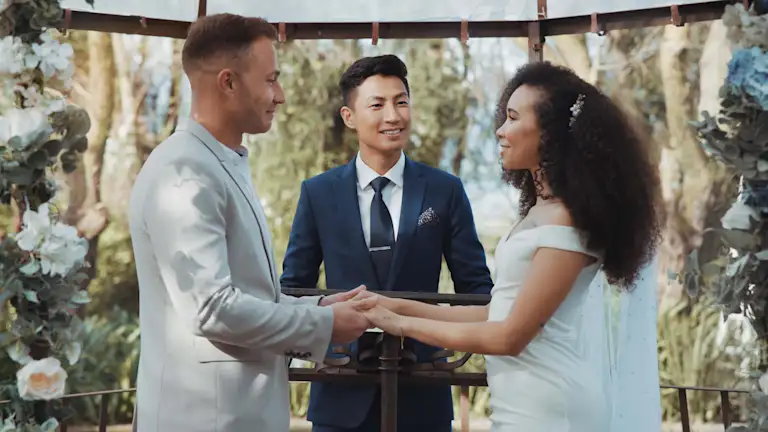
Planning to get married in British Columbia? Here’s what you need to know about the legal requirements and the steps to get married.
Quick summary
To get married in BC:
get a marriage licence ($100, valid for three months)
have the ceremony performed by a marriage commissioner or registered religious official
have two witnesses age 19 or older present
You do not need to live in BC to marry here.
After the ceremony, the officiant registers the marriage, and your marriage certificate is mailed to you.
Looking for quick answers?
Visit our getting married FAQ for short answers to common questions. This guide explains the requirements in more detail and walks you through the steps.
What you should know
To legally marry in BC:
Neither of you can already be married to someone else. If either of you was married before, you must show proof the marriage legally ended.
You can’t be closely related. Under this law, you can’t marry a close relative, including a parent, child, sibling, half-sibling, grandparent, or grandchild — including through adoption.
You must usually be at least 19 years old. If you’re under 19, you can get married, but only with permission; see below, under common questions.
Both of you must understand and freely agree to the marriage. You must also understand what marriage means legally, including the responsibility to support each other financially.
Yes. Same-sex couples can legally marry in British Columbia and throughout Canada. The same marriage laws apply to all couples.
“My partner and I are getting married next month. Last week I picked up our marriage licence from a local notary public. It only took about 15 minutes. Now we just have to remember to actually bring it to the ceremony!”
– Zach, Williams Lake, BC

You don’t have to live in BC, take a blood test, or marry in a religious building to get legally married here. But you do need a marriage licence. (Below, we explain what’s involved in getting one.) A marriage licence lasts for three months from the date of purchase. If you haven’t married by then, the licence expires and you’ll need a new one.
If you were married before
If either of you was married before, you must show proof that the marriage legally ended before you can get a marriage licence. Usually, you’ll need the original or a certified copy of one of these:
a divorce order
a certificate of divorce
an annulment
If you don’t have your divorce documents, you may be able to get copies from your lawyer or the courthouse where the divorce was filed. The BC government website explains how to obtain a certificate of divorce.
To legally marry in BC, the ceremony must be performed by someone authorized under BC law. This includes:
a marriage commissioner who has completed a government training program, or
a religious official registered to perform marriages in BC (not all religious officials are registered, so ask before they perform the marriage).
If you want a religious ceremony performed by someone who isn’t registered in BC, you can first have a short civil ceremony with a marriage commissioner to legally marry. After that, you can have a religious ceremony with any religious official.
The marriage commissioner or religious official who conducts the ceremony will typically help you register your marriage with the Vital Statistics Agency. This is the government office that records all marriages in BC. We explain how this works below.
The officiant may give you a commemorative certificate at the ceremony. This is not the official government marriage certificate. Your legal marriage certificate comes later from Vital Statistics after your marriage is registered.
Steps to get married
Apply in person for a marriage licence
Bring ID for both people getting married
Costs $100
One of you must apply for the marriage licence in person. You must bring identification for both of you. The marriage licence costs $100.
You can get a licence from a Service BC office, many insurance agents, or some notaries public. The BC government website has a search tool you can use to find a marriage licence issuer near you. Or you can contact the Vital Statistics Agency.
A note on the ID you must bring. It must be primary identification for both of you, such as a birth certificate or a citizenship card. (The marriage licence issuer may accept a passport or driver’s licence in some circumstances.)
Book a marriage commissioner or religious official
Have two witnesses who are age 19 or older
Witnesses must attend the ceremony
You’ll need to book a marriage commissioner or registered religious official to perform the marriage ceremony (see above, under who can legally perform a marriage in BC). You can search for marriage commissioners in the community where you’re getting married. They will charge a $75 base fee, plus tax, and possibly additional fees for things like extra time, transportation and parking.
You don’t need to publicly announce the marriage beforehand. But at least two witnesses who are age 19 or older must be present at the ceremony. (The marriage commissioner or religious official doesn’t count as a witness.) The witnesses don’t need to be family members or close friends. They just need to be at least 19 and present at the ceremony.
Everyone signs the registration paperwork after the ceremony
The officiant usually sends it to Vital Statistics within 48 hours
Your marriage certificate usually arrives within about three weeks
After the marriage ceremony, the two of you — plus the two witnesses and the officiant who married you — must sign the marriage licence and a registration of marriage form.
Within 48 hours of the ceremony, the officiant usually sends the registration form to the Vital Statistics Agency. If you’re not sure, ask them if they will.
The Vital Statistics Agency will send you a marriage certificate. This is automatically mailed to you about three weeks after registration.
“After our wedding ceremony, our officiant took care of sending the paperwork to Vital Statistics — we didn't have to do a thing. A few weeks later, our official marriage certificate showed up in the mail.”
– Anaya, Surrey, BC
Common questions
If you are married by a marriage commissioner in a civil ceremony, the minimum legal cost is $175, plus tax on the commissioner's fee.
That breaks down as:
$100 for the marriage licence (set by the BC government; the same price everywhere in the province).
$75 plus tax for the marriage commissioner’s base fee. Commissioners may charge additional fees for travel, parking, and time spent over the one hour included in the base civil ceremony.
If you're married by a registered religious official instead, their fee will vary. Many religious officials don't charge a set fee but accept a donation to the place of worship.
These are just the legal costs of getting married. They don't include things like rings, a venue, photography, attire, or a reception. You can keep things very simple — a commissioner, two witnesses, and a quiet location — and the whole legal process can cost under $200.
Only if they're already authorized to perform marriages in BC.
Unlike some places — including several US states — British Columbia does not allow you to deputize a friend or family member to perform your wedding for the day. The person who marries you must already be either:
a marriage commissioner appointed by the BC government, or
a religious official registered to perform marriages in BC.
If a friend or family member is one of these, they can legally marry you. If they're not, they can still play a meaningful role in your ceremony — giving a reading, offering a blessing, sharing remarks, or guiding the proceedings — but they can't be the one who legally marries you.
A common workaround: have a licensed marriage commissioner perform the brief legal portion of the ceremony, and have your friend or family member lead the rest of it. At the point the commissioner pronounces you married and signs the paperwork, you're legally married. Everything else — the vows you want to write, the people you want to hear from, the rituals that matter to you — can be shaped however you like.
If you'd like your friend or family member to become a marriage commissioner permanently, the BC government accepts applications, but appointments are limited and based on need in a given community. The marriage commissioner program explains the requirements.
Yes. British Columbia has no waiting period between getting your marriage licence and the ceremony.
Once one of you has gone in person to pick up the licence, you can legally marry that same day, as long as you have:
the marriage licence in hand at the ceremony,
an authorized officiant (a marriage commissioner or registered religious official), and
two witnesses aged 19 or older.
The licence is valid for three months from the date of purchase, so you also don't need to rush. Many couples pick up the licence a few weeks before their planned ceremony date, just to be safe — but legally, same-day is fine.
If you're hoping for a same-day or short-notice ceremony, call marriage commissioners in your area to check availability. Some keep slots open for short-notice bookings; others book up months in advance, especially in summer.
Your official marriage certificate is automatically mailed to you about three weeks after your marriage is registered with the Vital Statistics Agency.
Here's the timeline:
Day of ceremony: you, your spouse, the two witnesses, and the officiant sign the marriage licence and registration of marriage form.
Within 48 hours: the officiant sends the registration paperwork to Vital Statistics.
About three weeks later: your marriage certificate arrives in the mail at the address you provided on the licence application.
The certificate you receive at the ceremony is usually just a commemorative copy, not the official government certificate. You'll need the certificate from Vital Statistics for legal purposes like changing your name, sponsoring a spouse for immigration, or updating your status with government agencies.
If you need your certificate sooner, you can request a rush service from Vital Statistics for an additional fee. If three weeks have passed and you still haven't received it, contact the Vital Statistics Agency at 1-888-876-1633.
No. Getting married doesn't automatically change your name in BC.
If you want to take your spouse's last name — or hyphenate or combine your names in some other way — you must take steps to do so. There are two main options:
Use your spouse's last name as an assumed name. After you marry, you can start using your spouse’s last name on documents and accounts such as your driver’s licence, BC Services Card, passport, and bank accounts. Your legal name does not change — you’re simply using another name in daily life. This is the most common option, and there is no fee.
Legally change your name. If you want your new name to become your legal name (the name on your birth certificate), you must apply for a legal change of name through the BC Vital Statistics Agency. There is a fee, and you must provide fingerprints for a criminal record check. See our step-by-step guide on applying for a legal name change.
No matter which option you choose, you must update your name separately with each government agency and organization you deal with, such as Insurance Corporation of British Columbia, the Canada Revenue Agency, your bank, and your employer. You will typically need to show your marriage certificate.
You don’t have to decide right away. You can keep your current name, change it later, or never change it at all. The same options are available to either spouse, regardless of gender.
Yes, with permission.
If you’re 16 to 18 years old, the law requires that for you to get married, you need written consent from every parent who is alive and has guardianship. (You don’t need written consent from a parent who is not a guardian.) If you have no living parents who have guardianship, you need the written consent of someone who is your guardian.
If you’re under age 16, you need to apply to BC Supreme Court for permission to marry.
Usually, yes. A marriage performed in another country is generally recognized as valid in Canada — including in BC — if both of these are true:
the marriage was legal in the country where you got married (you followed that country's rules for getting married there), and
the marriage meets Canada's federal marriage laws (for example, both of you were free to marry, neither of you was already married to someone else, and you weren't too closely related).
If your marriage meets both requirements, you don't need to register it again in BC. Your foreign marriage certificate is generally accepted as proof of marriage.
If the certificate isn't in English or French, you may need a certified translation when using it for government or legal purposes in Canada — for example, when applying to sponsor a spouse for immigration, to change your name, or to get divorced.
A few examples of situations where a foreign marriage may not be recognized in Canada:
Polygamous marriages. Canadian law only recognizes a marriage between two people.
Proxy marriages. These marriages — where one or both spouses weren't physically present at the ceremony — may not be recognized for certain immigration purposes.
Marriages that don’t meet Canada’s federal marriage laws. For example, a marriage involving someone who wasn't legally divorced from a previous spouse.
If you're unsure whether your marriage will be recognized in Canada — especially for immigration, divorce, or estate matters — consider speaking with a lawyer.
If you're planning to marry elsewhere
If you're planning to marry outside Canada, contact that country’s embassy or consulate before you go. They can tell you what documents you’ll need and whether any documents must be authenticated or translated. The government of Canada's overseas marriage information is also a good starting point.
Someone can object to a marriage by filing a legal notice called a caveat with a marriage licence issuer.
Caveats are rare. They’re usually filed when someone believes a couple does not legally qualify to marry — for example, because one person is already married, is underage without proper consent, or cannot understand the nature of the marriage.
A caveat must be based on a legal reason, not personal disagreement with the relationship.
If a caveat is filed, a marriage licence won’t be issued until the concern is resolved or the caveat is withdrawn.
Who can help

Vital Statistics Agency
The government office that records all marriages that occur in BC.
BC Legal Referral Service
Helps you connect with a lawyer, notary or paralegal for a free 15- to 30-minute consult to see if you want to hire them.
BC Legal Directory
Search for a lawyer by community, area of law, or language spoken. From the Canadian Bar Association, BC Branch.